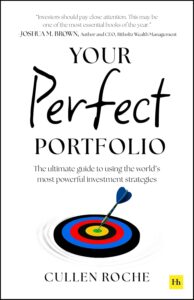
 There is no perfect portfolio, but there are portfolios that work better for you and at different points during your life. Cullen Roche in his new book Your Perfect Portfolio: The Ultimate Guide to Using the World’s Most Powerful Investing Strategies takes a comprehensive look at the many portfolio options investors, and their advisors, have when it comes to building a better financial life.
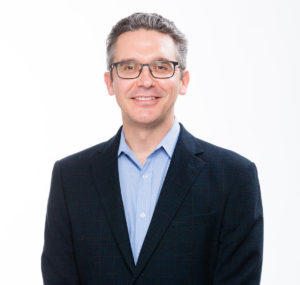
Cullen is the Founder and Chief Investment Officer of Discipline Funds. His firm is the manager of three Defined Duration ETFs. This is Cullen’s second book, his first being Pragmatic Capitalism: What Every Investor Needs to Know About Money and Finance. Also Cullen was recently on the Meb Faber Show, Morningstar’s The Long View and Odd Lots to talk about the new book.
I had the pleasure to ask Cullen some questions about the Your Perfect Portfolio. Below you can find my questions in bold. Cullen’s (unedited) answers follow. Enjoy!
AR: You list 10 investing principles near the beginning of the book. I think #1, “You are a saver, not an investor” is the one most people get wrong. Why is that?
CR: This is a strange one, huh? How can the word “investing” be so muddled in the investing world?
The word investment has different meanings in the fields of economics and finance. In economics it means to spend for future production. Firms do this when they build a factory, for example. In finance investment means to allocate capital with the intent to make money. The kicker is, when you buy shares of stock on a secondary market you aren’t spending for future production, you are reallocating your savings by buying shares of an instrument whose value is reflected by the way the firm spends for investment.
This may seem mundane, but the mentality is important. Investment is a long-term process that requires patience and consistent effort resulting in a return on investment. Investment spending creates savings that accrues as value in your assets over time. I think many people get this backwards and get into portfolio construction thinking they’re doing something sexy, which is what “investing” is often portrayed as. They don’t think of it as allocating their savings so they often set false expectations right out of the gate. But when you approach it from the perspective of allocating your savings it takes on a different meaning, one that involves prudence, process and discipline over time. That’s why I often call portfolios savings portfolios and not investment portfolios.
AR: Your book is an exploration of portfolio strategies, but you note that our needs change over time. For instance, the need for simplicity as we get older. Any other things to keep in mind?
CR: Portfolio management is an evolving process. I call it a “temporal conundrum” in the book because we’re all navigating our ability to consume across time and we need our portfolios to accrue the value that makes that consumption viable. So I really tried to emphasize the fact that good portfolio construction requires maintenance and evolution because our lives will change, our needs will change and our assets will have to fund different things in different ways as our lives change.
AR: As important as risk is, and as much as people on TV talk about it, there is no universal risk. Why is risk different for each individual?
CR: I like the Ken French definition of risk – risk is uncertainty of future consumption. This encompasses many different types of risk including volatility, costs, behavior and unknowns. All of these things can harm our ability to consume in the future. And so you need to have a plan and a process that will help you mitigate all of the things that might harm your ability to predictably consume in the future.
AR: Your analysis of Warren Buffett made me chuckle. It highlights how from one individual we can come up with very different investment strategies. Is that THE theme of the book?
CR: It really is. I didn’t name the book “THE Perfect Portfolio” because there’s no such thing. Each person is different and has to find their own perfect portfolio. You can’t just read some stuff about the huge successes of famous investors and then assume their portfolio will work for you because their life and needs were completely different from yours. I use the analogy of finding a spouse in the book – you have to find the person who is compatible with you. Likewise, you have to find the portfolio that you’re compatible with and stay loyal to it.
AR: I like your analysis of the GFAP (Global Financial Asset Portfolio). Intuitively this should be every saver’s baseline/benchmark. Can you mention some of the surprising downsides of the GFAP?
CR: The GFAP is fascinating because it highlights how active we all really are, since no one can track that portfolio. The thing I found most interesting about the GFAP is the way it’s measured on a free float or full cap basis. You can’t really own the GFAP because most of its assets aren’t investable. And the actual outstanding assets are very different than what’s investable. For instance, if you buy the free float (investable) portfolio you end up with 65% US stocks. But if you allocated to what the actual issuance (full cap) is, then you have just 45% US stocks. That’s a pretty huge difference.
I used to rant about this 10 years ago in “active” vs “passive” debates, but it really goes to show that we’re all active and that’s fine. There can be totally sensible reasons to be active.
AR: Taxes matter. In this approach it’s difficult to measure the tax consequences of these strategies, including asset location etc. Of late there have been a lot of new approaches to taxes (direct indexing, 351exchanges, etc.) How should savers approach taxes on their investments?
CR: Taxes and fees are hugely important factors in your overall real, real, returns. But I like to emphasize that they’re secondary factors in the process of maintenance. For instance, the lowest cost instrument isn’t always the best instrument. Trying to eliminate taxes could reduce gross gains in a way that results in huge opportunity costs. Or it can just make things more complex for no good reason. So it’s a balancing act. I always tell people to build the right allocation that matches your plan and then make that allocation as tax and fee efficient as is appropriate. But don’t lead with taxes and fees.
AR: How long have you been thinking about the Forward Cap approach? I have not seen you write about it previously.
CR: I’ve secretly operated a portfolio similar to this for a long time now in my retirement accounts, although it wasn’t as methodical as the one laid out in the book. For instance, I’ve had a long standing view that technology would eat up more and more of the overall S&P 500 because e-commerce as a % of total retail sales is still relatively small. In the book I extrapolate this trend out to get an idea of where tech might be heading. But I wouldn’t be shocked if my estimates in the book are conservative actually.
This is the first time where I actually sat down and created a rigorously outlined asset allocation based on a diversified group of mega trends. It was one of the more enjoyable portfolios to work on in the book because I think it’s original, empirical, innovative and practical for the very aggressive investor.
AR: Are there some approaches that can’t really be simplified for DIYers? For example Risk Parity or the Endowment Portfolio?
CR: Yes. There are wrappers that make it easy to own the strategy, but some of the strategies are just inherently complex and difficult to implement on a DIY basis. It was almost strange writing the endowment chapter because it’s probably more appropriate for a big team of investors instead of a DIYer. You can start betting way too complex when you get deep in the weeds around some of this and a common theme throughout the book is that perfect is the enemy of the good.
AR: Are true uncorrelated assets hard to find? Going through your book only gold and trend following really jump out as true diversifiers.
CR: They are! It’s one reason I’ve become such a big advocate of temporal diversification. There just aren’t that many asset classes that offer true uncorrelated performance. And even then they sometimes all become correlated at times. So it’s especially hard to find assets that are uncorrelated and remain uncorrelated consistently. Trend Following is one that is typically uncorrelated, but it will also really test your patience as it can become uncorrelated in a bad way for long periods. Temporal diversification is one way to add diversification to a portfolio that is more systematically reliable.
AR: Why do the great investors (Buffett, Dalio, Bernstein, Swensen) all recommend seemingly simple portfolios?
CR: I think you get to a certain age and realize “man, life is complex and I need processes that simplify it as much as possible”. There’s this belief that investing should be complex and sophisticated, but in many ways you get more from doing less. It’s addition by subtraction in a lot of cases. But again, it’s a personalized balancing act.
AR: I’m glad you mention housing in your book. It is people’s biggest asset (or ongoing expense). How should we think about our house a part of our financial lives?
CR: It’s tough. Housing has elements of consumption and investment in the sense that it’s an asset that you can invest in (eg, by remodeling a bathroom or adding square footage), but it’s also just something you’re consuming over time since there are so many costs to owning a home. But then there’s even a third element – comfort! Owning your house is a super personal decision. It’s where you’ll raise your kids, eat most of your meals and enjoy all the comforts of everyday life. You want this place to be yours, not someone elses. And that adds a whole other element in which your house isn’t just a financial decision, it’s very much a personal decision.
I often joke that there are intangible benefits to owning a home such as the ability to drive a bulldozer through it. Which is something I actually did to my house after I bought it. You can’t put a price tag on that.
AR: Defined duration is a sophisticated way to structure a financial plan. Is that something an individual can do, or is it really best done with a financial advisor?
CR: I worked with some banks after the financial crisis on their asset-liability matching (ALM) processes and it dawned on me that every investor has this same problem – they need to match assets to certain liabilities. In fact, I realized that our risk profiles are largely a function of this. When you sell stocks in a downturn you aren’t selling because you’re scared. You’re selling because you have an asset-liability mismatch. You don’t have enough cash and safe assets in your plan to keep you comfortable and you sell stock because you need more cash.
The strange thing is that even though many institutional investors do ALM, most retail investors don’t. Or they don’t have a good process and/or product options to implement it. I am trying to fix that and give retail investors and financial advisors a simple, but streamlined ALM process.
In my view it’s probably best implemented with a financial planner because they can rigorously structure the liabilities and help you pick the matching assets, but there’s no reason this couldn’t also be a very simple DIY process. I’ve been working on some tools to help people understand this including our HourglassFP tool, which is designed to build a systematic ALM based portfolio through a relatively simple three step process. I am convinced that most good financial planning will be done thru an ALM process in the coming 20 years. It is just too intuitive and sensible and most importantly, it aligns perfectly with a financial planning process.
AR: Cullen, thanks for your time. Good luck with the book!
*Full disclosure: Harriman House sent me a copy of his book.