Went through the Apple icons and can confirm: looking at them in reverse chronology is watching someone getting better at drawing. https://t.co/mGRoqHmZSI pic.twitter.com/vCqTes3w11
— Trung Phan (@TrungTPhan) January 19, 2026
One thing that Apple was known for was great graphic design, going from the Apple II to the Mac, the iPod and iPhone. If you look above it looks like Apple’s approach has changed, and not for the better. You can see similar results for another batch of icons, for the Apple Creator Studio as well. In short, their icons have become enshittified.* If it were just about icons, it wouldn’t be a big deal.
But enshittification is bigger than that. Here is a good, quick definition:
The social media platforms, e-commerce sites and search engines they were using had noticeably deteriorated in quality. Many had begun to prioritise content from advertisers and other third parties. Profit became the main goal.
Cory Doctorow, author of Enshittification: Why Everuthing Suddently Got Worse and What to Do About It, has posited that a host of technological, legal, and economic have led us to this point. In short, if you feel like your online platforms are getting worse, showing more ads, charging more and simply taking advantage of you, you’re not crazy. A lack of regulatory oversight and lax anti-trust enforcement have allowed the biggest internet companies to become untouchable and wildly profitable.**
We have included some links discussing Doctorow’s book and some of his recent writing on the topic.*** The bottom line is that companies in the tech sector, and elsewhere, have been able to raise the profitability by squeezing users, customers, employees, and suppliers. You could argue that overall enshittiication of the economy has shown up in rising corporate profit margins.
Ben Carlson at A Wealth of Common Sense has a graph that shows a stair-step like pattern for American corporate profit margins. For the longest time it was believed that corporate profit margins were mean-reverting. That no longer seems to be the case.
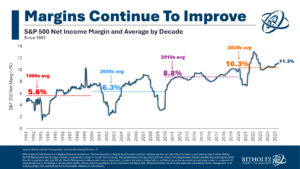
It could be that the nature of the American economy has changed. The growing importance of technology allows for more efficient companies. Or enshittification is goosing corporate profit margins to the detriment of all the other stakeholders in the economy.
A couple of weeks ago the BLS reported that labor’s share of GDP fell to its lowest level on record. As you can see this number was largely stable through the beginning of 21st century. But ever since then has been falling to its current low levels. One exception would be the 2020-21 during the Covid-19 pandemic when workers had the upper hand. That leverage was quickly lost during the recovery.
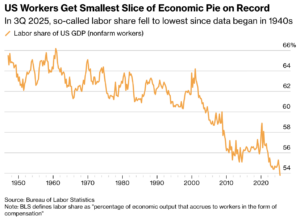
The math is pretty simple. The less workers are paid, the higher the profits. Which the stock market, by the way, loves. Over the past decade, U.S. large cap stocks have trounced other asset classes, including small cap stocks. Those companies presumably have less market power over their customers and employees.
We will leave it to to smarter people to figure out how the widespread use of generative AI will affect corporate profit margins. It’s hard to see how it makes for a rebound in the share going to labor. This may help explain why the vibes around the economy remain moribund.
Everybody loves a rising stock market. American workers are dependent on the stock market for their retirements, among other goals. A healthy, well-functioning society is more than just a system by which corporations generate profits. It encompasses a lot more.
Your 401(k) statement may be showing big gains right now. If those gains are coming at the expense of the enshittification of everything else we should take a beat, and ask if that is what we really want.
*We generally don’t use swear words in our posts, but it’s hard to avoid it here. This dictionary chose enshittification for it’s word of the year for 2024.
**The leaders of these tech giants were welcome guests at the second Trump inauguration and have seen their profits and profiles rise over the last year.
***Some additional links: The Age of Enshittification, How the Internet Became Enshittified, Trump May Be the End of Enshittification, AI Companies Will Fail. We Can Salvage Something From the Wreckage.