Some 1 in 6 Americans are 65 years old and up. That absolute (and relative) number is only going to go higher. And with age comes a higher incidence of cognitive issues.
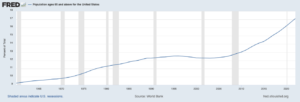
Source: FRED
According to the Alzheimer’s Association’s 2024 Alzheimer’s Disease Facts and Figures report, nearly 7 million Americans are living with Alzheimer’s disease. That number is expected to double by 2050. There is some hope that testing can help predict those most at-risk. There are some signs of hope on the horizon whether it be through pharmaceutical treatments or other forms of intervention.
But the fact remains that a growing number of Americans are at-risk of some form of cognitive decline. In addition, more Americans are entering this time of their lives without partners or other family members. This isolation can amp up the risks.
There are any number of good reasons to engage with a financial advisor. An increasingly important one is to provide a buffer between an aging client and the dangers of cognitive decline. Whether we want to admit it, or not, our financial cognition will decline over time. A trusted third-party can be a valuable resource to help buffer the risks of cognitive decline.
Research shows that cognitive decline is evident even before a final diagnosis. Ben Casselman writing at the New York Times looks at some recent research.* He writes:
Credit scores among people who later develop dementia begin falling sharply long before their disease is formally identified. A year before diagnosis, these people were 17.2 percent more likely to be delinquent on their mortgage payments than before the onset of the disease, and 34.3 percent more likely to be delinquent on their credit card bills. The issues start even earlier: The study finds evidence of people falling behind on their debts five years before diagnosis.
Failing cognition shows up not only the credit side of the ledger, it also shows up on the asset side as well. A recent paper talks about how cognitive decline manifests in investment portfolios.**
We investigate whether older people correctly perceive their cognitive decline and the potential financial consequences of misperception. First, we show that older people tend to underestimate their cognitive decline. We then show that those experiencing a severe decline but unaware of it are more likely to suffer wealth losses. These losses largely reflect decreases in financial wealth and are mainly experienced by wealthier people who were previously active on the stock market. Our findings support the view that financial losses among older people unaware of their cognitive decline are the result of bad financial decisions, not of rational disinvestment strategies.
Admittedly worse than either of these outcomes is the increased risk of fraud facing older Americans. Diminished capacity plays a role in the ability of scammers to rip off older people. There are other factors as well, including a lower digital literacy. Unfortunately, a significant part of elder financial fraud comes from those with a close relationship as opposed to someone online or on the phone.
A financial advisor is not the sole defense from the dangers of diminished financial cognition. The most important person is the client themselves and their willingness to put legal and financial safeguards in place before they are actually needed. Financial institutions are also in the business of preventing fraud. More anti-fraud efforts tailored to the unique risks of an aging population will be needed. Hopefully AI can help as well.
No one thinks that cognitive decline will play a negative role in their financial life. But Father Time is undefeated. It behooves everyone to be proactive knowing that while retirement can be a time of increasing happiness, it also comes with challenges as well.
* “The Financial Consequences of Undiagnosed Memory Disorders,” Gresenz, Mitchell, Rodriguez, Turner and van der Klaauw, No. 1106, May 2024, Federal Reserve Bank of New York.
** “Are Older People Aware of Their Cognitive Decline? Misperception and Financial Decision-Making,” Fabrizio Mazzonna and Franco Peracchi, Journal of Political Economy, Volume 132, Number 6, June 2024.