It’s a horrible cliche, but the idea that stock markets are in the short term voting machines, and in the long term weighing machines rings true. One of the reasons for this is that when events, or policy changes, happen we don’t exactly know how they will play out. We only understand that in the long run.
Historically, the populace of country typically elect populist leaders because they are highly dissatisfied with the state of the country and its economy. Research shows that this often represents an own goal on the part of voters. A 2023 paper Populist Leaders and the Economy by Funke, Schularick and Tresbach looks at this very phenomenon. From the abstract:
Populism at the country level is at an all-time high, with more than 25 percent of nations currently governed by populists. How do economies perform under populist leaders? We build a new long-run cross-country database to study the macroeconomic history of populism. We identify 51 populist presidents and prime ministers from 1900 to 2020 and show that the economic cost of populism is high. After 15 years, GDP per capita is 10 percent lower compared to a plausible nonpopulist counterfactual. Economic disintegration, decreasing macroeconomic stability, and the erosion of institutions typically go hand in hand with populist rule.
The sugar high of voting out incumbents unfortunately leads to worse economic outcomes. Simon Wren-Lewis at mainly macro highlights why these populist leaders often don’t get displaced very quickly. He writes:
One obvious question is why, if the macroeconomic impact of populist governments is so bad, they don’t get voted out of power quite quickly. Unfortunately they generally don’t. The paper estimates that on average populist governments tend to stay in power longer than other governments. There are two reasons for this depressing result. First, populists rig the democratic system to make their re-election more likely, either directly through gerrymandering for example or by restrictions on press freedom. Second, the social and economic reasons for the rise in populism tend to be persistent.
The erosion of institutions, the degradation of the press and the flouting of norms all serve to help keep populist regimes in place. There is a clear link between democracy and economic freedom. Alex Tabarrok who blogs at Marginal Revolution has a new paper, Two Peas in a Pod: Democracy and Capitalism, with Vincent Geloso that looks at the theoretical and empirical relationship between these two structures.

One can see from the graph a strong relationship between democracy and economic freedom. Hong Kong and Singapore being notable outliers. In their paper they also look at specific historical examples where changes in the form of government, like the fall of the Berlin Wall, helped generate greater economic freedom for their citizens. Tabbarok and Geloso also note capitalist democracies tend to be stable. They write:
Capitalist democracy isn’t quite the same as unmarried bachelor but it is true that democracy and capitalism are highly correlated both today and in the past. Moreover, countries that increase in capitalism also tend to increase in democracy and vice-versa. Contrary to both the democracy undermines capitalism and capitalism undermines democracy arguments we find that capitalistiont democracies tend to be stable. Capitalism and democracy are so highly correlated that it’s often difficult to ascribe consequences to one or the other.
If capitalist democracies tend to be stable, we should be on high alert when we see the potential for negative shocks to the system. With so much of our lives being lived online these days, the impact of governments on online discourse can be profound. For example, the Freedom of the Net 2025 report from Freedom House is out and shows that global internet freedom declined in 2025. They highlight trends in the United States that should give us pause.
While the United States retained its overall status of Free, growing restrictions on civic space drove the decline in its score. The administration of President Donald Trump detained several foreign nationals for one to two months after revoking their visas over nonviolent online expression, as part of a larger program to arrest and deport noncitizens. The Federal Communications Commission and the Federal Trade Commission threatened or carried out politicized investigations into civil society organizations and media and technology companies, often focusing on their content moderation, editorial decision-making, or forms of speech that are protected by the US Constitution’s First Amendment. More broadly, the administration’s actions have chilled the atmosphere for digital activism.y
On the flip side, when a country become more free and capitalistic there are likely going to be greater opportunities for investors. All of the data we are talking about here are somewhat fuzzy and confounded by all manner of other macro effects. There is, however, one ETF, the Freedom 100 Emerging Markets Index,* that uses data to invest in emerging market countries (and companies) that are freer, by these standards. The ETF launched in 2019, so the data is somewhat limited, but you can see that since inception the fund has outperformed the mainstream emerging market index.
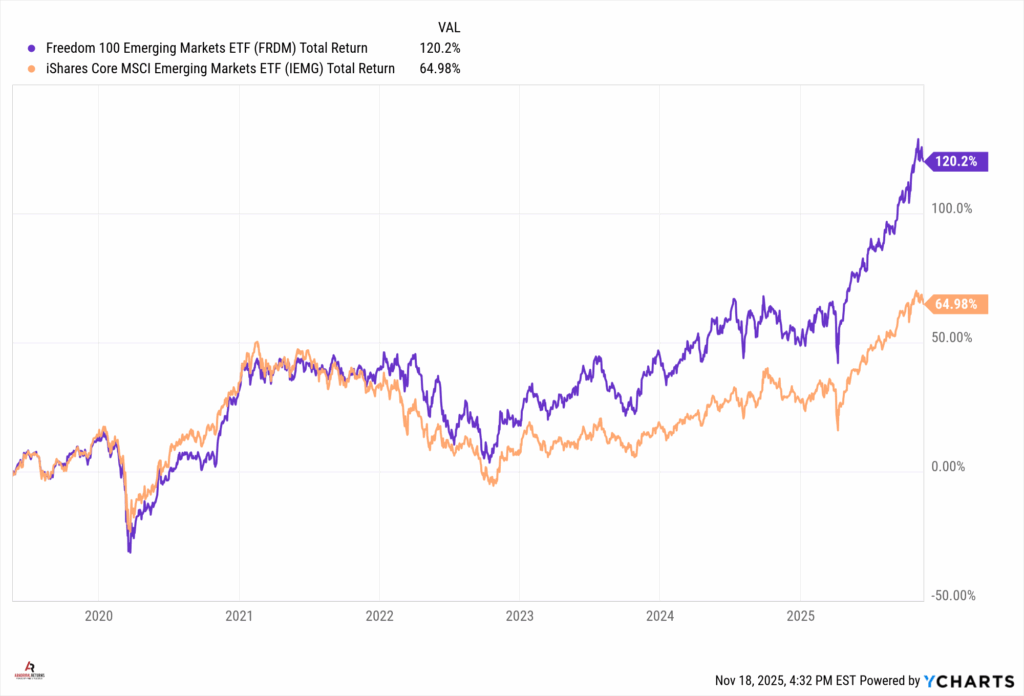
This is but one data point, but an interesting one nonetheless. As investors we need focus on the potential long term damage that populist leaders can do the underlying scaffolding of democracy and economic freedom. While there may not be short term consequences for these actions, over the long run the economy and stock market will feel the degradation of institutions and stability.
*No position, but an admirer of what Perth Tolle has built.