A lot of (virtual) ink has been spilled about the vibecession. That is the seeming disconnect between robust economic (and financial) results and weak consumer sentiment. Derek Thompson in a recent post, and podcast episode, looked a host of factors that could be happening. Some of these trends were in place before the pandemic, but a not insubstantial part can be tied to the pandemic. Thompson, in conclusion, writes:
American sadness this decade has been forged by the fact of, and the feeling of, a permanent unrelenting economic crisis, amplified by a uniquely negative news and media environment, and exacerbated by the rise of solitude and the declining centrality of trusted institutions. Inflation has made today’s life harder to afford, while the ambient awareness of other people’s triumphs on social media had made tomorrow’s success feel harder to achieve.
For a brief moment let’s tease out the inflation aspect. The 2010s were a decade of quiescent inflation. 2% as far as the eye could see. In short, nothing to see here. One of the great macro debates was why inflation was so low for so long.
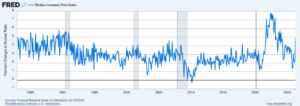
The pandemic changed all that. So did the Ukraine war, tariffs and now a war in Iran. A series of upward inflation shocks. The problem is that economists talk in terms of inflation rates, whereas consumers experience prices. So the inflation of the 2020s has created a felt experience of higher prices. This experience will continue for some time, no matter what inflation does in the meantime. (Which is higher for longer.)
In a recent paper, The Way We Were: Price-Level Shocks and Consumers’ Memories by Bernstein and Posthumus address this very issue. They write:
In other words, the results from this part of our research underscore that one cannot begin to understand how people experience price changes by simply looking at the ups and downs of yearly inflation, especially around a shock. It is also essential to account for people’s memories and expectations, not solely with respect to the monthly or yearly change in prices, but also regarding price levels. It is also important to account for their longer-term experiences of price movements. Our findings suggest that a huge storm after a long calm can be more upsetting to people who are not used to bad weather.
Put simply if gasoline prices were to go from $5 a gallon instantly to $10 a gallon, consumers would experience 100% gasoline inflation for a year. However a year a day later, after the final $5 prices drops off, annual gasoline inflation would now be 0%. But consumers still remember that $5 price and will continue to have an impact on their feelings.
G. Elliott Morris and David Nir at Strength in Numbers illustrate this phenomena using CPI. In the graph below they show how excess inflation shows up in higher felt prices. In fact, excess inflation should not be wrung out of the system until April 2029! That assumes, of course, that we don’t have additional upward inflation shocks in the future.
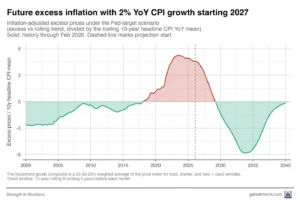
As mentioned above, higher prices are only part of poor sentiment. But understanding the impact of the flow of inflation on the level of prices is an important aspect of felt consumer felt experience.
Nobody knows when the impact of the closure of the Strait of Hormuz will abate (negative), or how an AI productivity boom (positive) will affect future inflation. But we know today that Americans are still feeling the impact of rising prices which started with the Covid-19 pandemic.