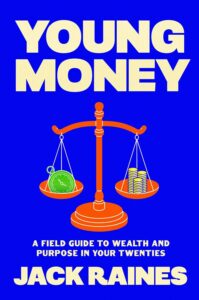
 I am not sure when I first got turned onto Jack Raine’s blog, but I have been a reader ever since. This despite the fact that I am way outside the demographic he is writing for. So I was excited to get a copy of Jack Raines’ new book Young Money: A Field Guide to Wealth and Purpose in Your Twenties. It is already zooming up the Amazon charts.
Jack is an associate at Slow Ventures and the author of the very popular Young Money newsletter. Jack was recently on Ask the Compound and The Long Term Investor to talk about the book. You can also read some excerpts from the book: here, here and here.
I had the pleasure to ask Jack some questions about the Young Money. Below you can find my questions in bold. Jack’s (unedited) answers follow. Jack was super generous with this time so this is a two-part Q&A. Stay tuned for part 2 tomorrow. Enjoy!
AR: Americans move less today than at any point in history. Can you really ‘blow up your life’ without moving?
JR: Short answer is yes, I think so. Blowing up your life can take a lot of different shapes. It could mean:
- Moving across the country or across the world.
- Ending a relationship that feels lukewarm.
- Going back to school, when it would mean a short-term earnings hit but would be long-term more lucrative for you.
- Making a complete career pivot.
- When I was 24 and just angsty about feeling like I wasn’t getting enough adventure in my life, I took off to backpack Europe before business school, and I lived in hostels for a year.
- The other time was the polar opposite. I was 27 and felt like I had made a wrong career move in my previous job, so I wanted to lean into something with more upside. I viewed that “something with more upside” as venture capital and the tech sector. A few months later, I moved to San Francisco on a whim for a job out there.
I don’t think moving is necessary to blowing up your life, especially if you live in a bigger city like New York or SF. You could blow up your life tomorrow and switch jobs or companies, but moving certainly feels a little more “real.” Also, while Americans might move less than at any other point in history, I would say it’s easier to move than at any point in history. You can find jobs online. You can interview remotely. You can do a lot of jobs remotely. The ease with which we can move means the stakes of moving are actually much lower than they were, because you could move back. So, no, you don’t “have to” move to blow up your life. But it’s never been easier to do so if you desire.
AR: Most people need experience to teach them about mortality. How did you come to recognize this so early in life?
JR: The honest answer is, I think, that I grew up religious. I grew up in the state of Georgia, going to a Southern Baptist church every Sunday and a lot of Wednesdays. I had a bit of an identity crisis going into college, I think, like a lot of people do, where you sort of just put religion on the back burner. You’re partying, going out with your friends, doing whatever, and it’s just a thing you push away, push away, push away.
What happened to me was that a year or two after graduating, I was 23. I was on a turbulent flight to Colorado with my girlfriend and two of my friends at the time. In my early to mid-twenties, I really hated flying, so I had this panic of, “Oh shit! The plane’s going to crash. We’re going to go down.” That obviously didn’t happen because I’m typing out this note right now, but it turbulence freaked me out a little bit.
My head went to, “Oh, you’re going to die,” and then the derivative of that was, “Well, then what?”
I had been putting off thoughts of religion and the afterlife and “what happens after we die?” until a turbulent flight brought that to the forefront of my mind. And then it came crashing down on me. It really wore on me. But it also gave me immense clarity: “Alright, I don’t have much time left in the grand scheme of things, so what do I want to do with it?”
AR: “The solved life” has always been a thing. Is the phenomenon worse today?
JR: I would say so, because we both have more free time or the ability to have more free time than people previously had. This whole white-collar job, 40-hour workweek is a pretty new thing. At least, the people working on computers who are fully removed from manual labor. I’m 29, so maybe my parents and me, and that’s it.
In a lot of jobs now, if you’re college-educated, you can make $100,000-plus without working very hard. That is a crazy thing to say, but it’s true because I see it all the time. I know plenty of people who kind of coast through what they’re doing. I’ve been that person before in different roles at times. When you can do that and still cover your cost of living and put a little bit of money back for retirement, when you don’t have to strive for a thing, you can subsist and have five hours of screen time a day watching social media.
What didn’t always exist was the amount of free time and distractions we face today. We fill that free time with meaningless slop, right? Nobody enjoys doing that. You feel unhealthy and gross after you’ve spent too much time on TikTok or Instagram or whatever, but they’re so good at looping you in. The ease with which we can slide into that, because your phone is 24/7, is hard, right? Free time, distractions, and the ability to survive with minimal effort create a different world than the one we used to exist in.
AR: Optionality is tricky. We all want it, but can be reluctant to exercise it. What do you think about Nick Maggiulli’s take on optionality?
JR: Yeah, I largely agree with Nick’s take that optionality is a depreciating asset and that the pursuit of optionality has cost.
The way I think about it, you can think about this in careers, relationships, really any aspect of your life in which you could pursue a deeper level of commitment. Optionality is incredibly valuable early on as you figure out what’s worth doubling down on. I think the worst mistake someone could make is just Insta-committing to a person or a career path or a city or college without doing the legwork of thinking through, “Am I very confident this is what I want to do with my life?”
But the flip side is that there’s always going to be some level of uncertainty, and you’re never going to have all the data. People who do commit to a thing then get to benefit from compounding. Again, that’s money, experiences, and relationships. Everything compounds. As long as you chase optionality, you can’t really compound, right?
My nuanced take on this is that optionality is valuable only so much as it gives the opportunity to find the things that do compound. Don’t get me wrong, optionality in the moment can be very fun, particularly when you’re young and you have high optionality. But what you don’t want to be is the person who’s 34 or 35 who never took dating seriously or jumped from job to job, and then they look around and everybody they went to school with is way ahead of them.
In your 20s, optionality is very valuable. As you approach your 30s, that optionality peaks and then begins to decline, right? What you want to be careful about is making sure to fully leverage it while it’s worth something. If you do find the thing that’s good, sooner or later you have to commit to something, or you end up getting stuck with whatever is left.
AR: “Every experience has an expiration date.” Great line. What experiences are still ahead for you?
JR: Several. I’m a single guy in my late 20s in New York, so marriage, kids, and probably buying a home at some point are ahead of me. I like to think that I’m going to have a pretty interesting career. I already have, right? I like being in the world of, call it, tech and investing. I don’t necessarily know what shape that world, and my role in it, will take over the next 5, 10, 15, 20 years, because frankly, the world today is so different than even four years ago. ChatGPT hadn’t come out this time in 2022, right?
In my professional life, I try to stay opportunistic and attack the things that seem most interesting and high leverage for me as they come to me. On the personal life side, a lot remains ahead, which is funny. In New York, people tell me I’m a kid. I go back home to Georgia, and all my friends from high school have kids, right? That’s certainly something that’s on my mind.
AR: You can talk about spending on what matters to you and saving ruthlessly elsewhere. Does this apply for 20-somethings or everyone?
JR: I think it applies to everyone, but it has to apply even more so to 20-somethings. If you’re in your 40s and at your peak earnings—making, if you’re lucky, several hundred thousand dollars a year or more—as long as your spending didn’t get out of control, you can spend without having to think too much about it. In your 20s, you’re broke, and you don’t have money. Once you cover your basic needs, there’s just only so much money you can spend without running out, and you have to make tradeoffs.
- How nice of an apartment do I desire?
- Do you have roommates or not have roommates?
- Do you go on the trip?
- Do you go out?
- What gym do you go to?
When you’re at your lowest-earning point of your career, you have to make choices, and there are going to be sacrifices and opportunity costs to those. I also think that’s good. Developing the ability to manage trade-offs at a young age only benefits you as you get older.
AR: Risk vs. uncertainty is an evergreen topic in finance. How does it apply to life?
JR: The difference between risk and uncertainty is that a situation is risky when the downside case could significantly impair you or your life, regardless of its probability. Something is uncertain when the worst possible scenario really isn’t that bad, but you just don’t know the odds of the different outcomes.
To give an example, cheating on your spouse would be incredibly, incredibly risky. But if you’re single, asking out a girl at a bar would likely just be uncertain. In the former, you risk blowing up your entire family, and in the latter, you might get curved, but then you’re sitting back where you were five minutes earlier.
This same thing applies to investing. When you’re near retirement age, and you have millions of dollars saved up, you face real risk if you are over-levered in tech stocks. A market downturn could materially impact your retirement while you’re no longer making money. Fixed income investments are your friend. But when you’re young, and you just don’t have that much money invested yet, you don’t have much to lose. Uncertain market conditions can’t hurt you.
AR: Stay tuned for part 2 tomorrow!
*Full disclosure: Jack sent me a copy of his book.