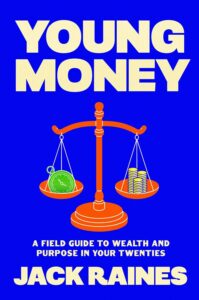
 I am not sure when I first got turned onto Jack Raine’s blog, but I have been a reader ever since. This despite the fact that I am way outside the demographic he is writing for. So I was excited to get a copy of Jack Raines’ new book Young Money: A Field Guide to Wealth and Purpose in Your Twenties. It is already zooming up the Amazon charts.
Jack is an associate at Slow Ventures and the author of the very popular Young Money newsletter. Jack was recently on Ask the Compound and The Long Term Investor to talk about the book. You can also read some excerpts from the book: here, here and here.
I had the pleasure to ask Jack some questions about the Young Money. Below you can find my questions in bold. Jack’s (unedited) answers follow. Jack was super generous with this time so this is part two two-part Q&A. First, check out part one. Enjoy!
AR: You got an MBA, but didn’t follow a traditional post-MBA path. Was it worth it? Would you recommend it to someone else?
JR: I would say, for me, it was worth it, but the MBA was only worth it because I went to a top 10 school, and I didn’t have a prestige stamp on my resume before that.
I think, as a general rule, if you get into Harvard Business School or Stanford Graduate School of Business, you should go every time. If you get into Chicago, Columbia, Wharton, Sloan, or other top 10 schools, you should probably go unless you’re on a real rocket ship of a career where it doesn’t make sense.
Below the top 10-ish names, the value of an MBA drops significantly. The median MBA is probably worth less than you spend to get it, but a top 10 MBA, for most people, is worth a lot more than you spend to get it. For a top two or three MBA, you’re kind of crazy not to get it.
Good MBAs are especially useful for people like me who went to normal regional universities. I went to Mercer University in Georgia. I worked in corporate finance for a Fortune 500 company for a couple of years, but I wanted to end up in the New York-Silicon Valley part of the world. Business school gave me a stamp of approval: “Okay, this kid was smart enough to get into this school, so obviously he’s qualified and has a certain level of intelligence or ambition.” It makes your ability legible in the absence of other evidence of your ability.
If you didn’t have the right undergrad or starter job to get that prestige stamp, yeah, it’s 100% worth it. If you’re trying to make a career pivot and just need time to map that out, business school is a professionally acceptable pivot that’s both fun but also just gives you mental bandwidth to think through and experiment with other stuff.
But if you like what you’re doing and you’re making good money and you see no reason to stop, then it’s probably not worth it. There will be an opportunity cost of lost income, and you might have to take on debt. But if you’re trying to level up from your current trajectory or make a sharp pivot, yeah, I think it’s still worth it.
AR: Most of your career has been built pre-AI. Does the rise of AI change any of your life/career advice?
JR: My career has actually kind of been split in thirds between pre-AI (graduated college in December 2019, chatbots being decent but not great (ChatGPT launch in November 2022 when I was in business school), and the recent uptick in AI coding assistant performance starting in December 2025.
The thing that I think changes is that tech feels like it’s accelerating faster and faster. A lot of work tasks that people just had to do are quickly getting commodified, from Excel to data synthesis to coding, AI can do a lot of this better than most people, particularly young people. But I still think knowing the base level of how to do a thing or how a thing works in whatever your career track is, is incredibly important. Actually, I think it’s a competitive advantage, because a lot of people will skip those basic steps since AI is such a powerful crutch, but this will only handicap them in the long run. Knowing the basics matters a ton now. Once you know the basics, AI gives you leverage.
But you do need to experiment with the AI to know where to apply that leverage, because the tech is advancing so quickly. You need to keep an eye on where the world is going, because I do think a lot of jobs, even if they aren’t getting deprecated, are changing. If you’re young, you can’t necessarily pattern-match against “what worked” 10 years ago.
AR: In the book you note how age matters. Can it matter too much, i.e. ageism?
JR: Regarding age, regardless of what I think should happen, people will always think you’re too young, too old, blah blah blah, for a task. People care about age, right? That’s just a part of human nature. It’s a part of life. Young people get more shots and longer leashes to mess stuff up, do stuff weird, not be good at stuff, and not have experience yet, because all people care about when you’re young is your energy levels. As you get older, you’re expected to be a pro, right?
There’s a belief that once you get too old, it’s harder for you to reset and learn new things, and you have to go above and beyond to prove people differently. Frankly, I think it would be cool for a lot of people if they could have a whole career for 10 or 15 years and then reset and go back to scratch and do another thing if they want to make a change. That’s not to say that you can’t do that. I know people that have done this very thing, going to law school in their 30s because they wanted to pivot from what they were doing to be lawyers. This is a thing that happens, but it’s hard. I think a lot of the problem is actually the ego hits involved. Do you want to be a beginner with a bunch of 22-year-olds when you’re 34? Self-imposed ageism is quite real.
AR: Everyone is on their own path, with their own goals. Would you choose ‘intentionality’ to describe the best way to stay aligned?
JR: Yeah, 100%. The word “agency” gets thrown around a lot in Silicon Valley, where I spend a lot of time now, meaning people who are willing to take initiative and do things. I think intentionality is more important than agency, because if agency is the velocity in which you do stuff, intentionality is the step that comes before that in discerning what’s worth doing in the first place.
There are a lot of distractions now. You go on social media, and you can just see what every person you’ve ever met is doing 24/7, and a lot of it is kind of fake. You see this version of people: you think they’re making a certain amount of money, which may or may not be true. You think they’re getting a certain amount of fulfillment out of what they’re doing, which may or may not be true. It’s easy to just start chasing shiny things based off of what you’re seeing online, which makes it so much more important to be intentional, because it’s just hard to be steadfast when there are just so many distractions in it.
Everything feels so existential and important, that the desire to be highly agentic and go after things, is tempting. But it takes intentionality to know what’s worth doing in the first place.
AR: Sometimes it feels like life is just status games all the way down. Has social media made it worse?
JR: Yeah, the relationship between status and social media is pretty interesting. Status and status anxieties and status games have existed as long as humans have. We don’t live in vacuums. We live in communities with other people, and we want to compare and contrast ourselves against those people.
The issue with social media is that it’s expanded how big a status game can get. Status games aren’t localized anymore. When it was just you and your immediate co-workers, your neighbors, and maybe your friends from college that you kept up with, that’s only a few dozen people you can actually compare yourself to. When you can see millions or billions of people living their lives across Twitter, LinkedIn, Instagram, and TikTok, it’s impossible not to feel like you’re behind some facet of your life, even if you’re objectively crushing it.
You’re going to see people making more money than you. People who are starting families before you do. People who are buying homes. People who are starting companies. You can just feel like you’re falling behind, despite the fact that, if you look at the numbers, there’s a very good chance that you’re making more than the median household or individual income. If you don’t have debt, you’re crushing it. But it doesn’t feel like you’re crushing it when you see people doing better than you, because, again, nobody actually fixates on people doing worse than them.
As soon as you level up and it’s a new level of status, you start comparing yourself to the person another step ahead of you.
AR: Everyone gets onto the wrong path at times. Is there a key to shaking off apathy to get back on course?
JR: Yeah, I think the key is momentum. Now, I mentioned in the last question that everybody feels like they’re always pulled toward another status game. We desire to be in motion, but the nice thing is, motion is kind of the cure for apathy. By apathy, I mean when you feel stuck in life and you’re floundering, and you just feel like you can’t get it together. You don’t have to solve everything in one day. You just have to make progress. That can be as simple as:
- applying to a job
- getting up and going to the gym
- making your bed
AR: Your career is one characterized by writing well and in the first person. Are you worried that writing won’t have the bang for the buck in the future?
JR: I think what I would call “broader prescriptive life advice” is getting commodified by AI. I think the ability to tell stories and communicate human experiences to other people is only going to grow more valuable because fewer and fewer people will be able to do it, because so many people outsource their writing to AI. This is just speaking in anecdotes, but so many of the messages and emails I’ve gotten from people who’ve read my book so far have this throughline: “This feels human. I feel seen. I resonate with these experiences.” I just think that that’s going to keep paying dividends.
I think in-person experiences are more valuable than ever. I also think being able to connect with people through writing that relates to them is just as valuable.
AR: Thanks for your time, Jack. Good luck with book!
*Full disclosure: Jack sent me a copy of his book.